 ambetoraja
The island of Sulawesi in Indonesia is home to many fascinating cultural traditions, and among the most remarkable is the funeral ceremony known as Rambu Solo’. Deeply rooted in the traditions of the Torajan people of South Sulawesi, Rambu Solo’ is a ceremonial event that honors the deceased while bringing together family members, relatives, friends, and communities to pay their final respects.
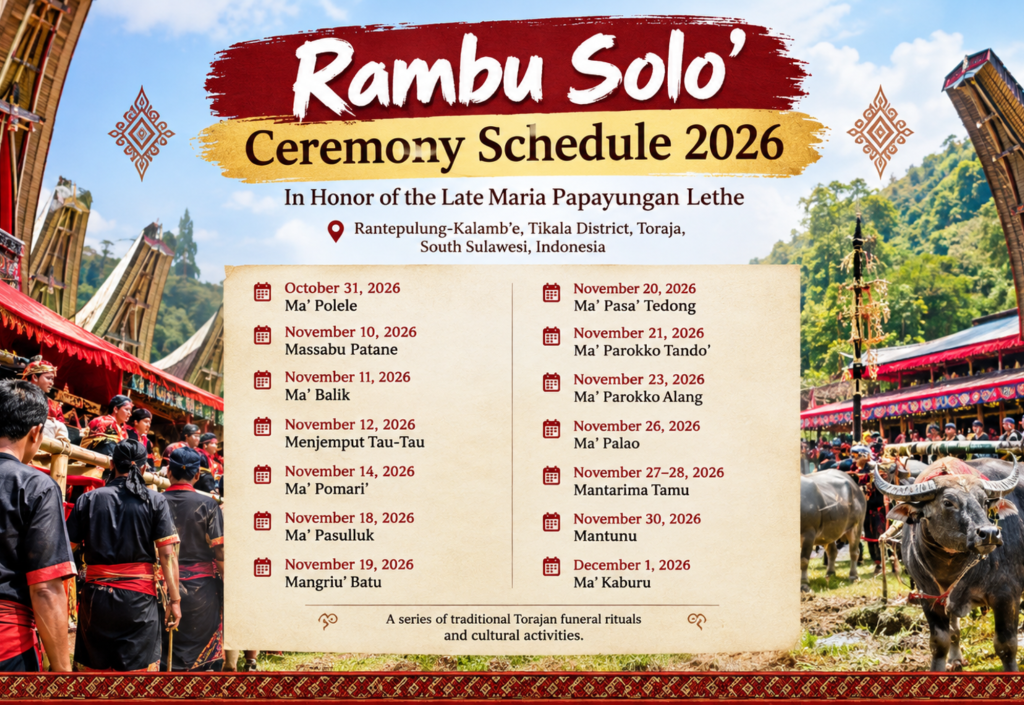
In 2026, a series of traditional Rambu Solo’ ceremonies will be held in honor of the late Maria Papayungan Lethe at Rantepulung-Kalamb’e, Tikala District, Toraja, South Sulawesi, Indonesia. The event features a long sequence of traditional activities scheduled from October 31 to December 1, 2026. Each activity forms part of a larger ceremonial gathering that reflects the cultural identity, family bonds, and ancestral heritage of the Torajan people.
This ceremony is not simply a funeral. It is an important cultural occasion that demonstrates how the Torajan community preserves its traditions and maintains a strong connection between generations.
Understanding the Rambu Solo’ Tradition
Rambu Solo’ is one of the most significant traditional ceremonies in Toraja. It is a funeral ritual performed to honor someone who has passed away and to provide a proper ceremonial farewell according to Torajan customs.
For the Torajan people, death is surrounded by a complex system of cultural beliefs, family responsibilities, and traditional practices. The funeral ceremony is often organized through careful preparation, involving extended families and members of the local community.
Unlike many modern funerals that take place over a short period, a traditional Rambu Solo’ can involve several days or even weeks of activities. The duration and scale depend on family circumstances, local customs, and the arrangements agreed upon by relatives.
One of the most recognizable aspects of Rambu Solo’ is the gathering of family members from different towns and regions. Relatives who live far away often return to their ancestral villages to participate in the ceremony. Friends, neighbors, and guests also attend, creating a large gathering that strengthens social relationships.
Traditional houses known as Tongkonan, ceremonial decorations, buffaloes, traditional music, and community gatherings are among the cultural elements that may be seen during these occasions.
A Special Ceremony for Maria Papayungan Lethe
The Rambu Solo’ ceremony for the late Maria Papayungan Lethe will take place at Rantepulung-Kalamb’e, in Tikala District, Toraja.
According to the announced program, the series of traditional activities begins on October 31, 2026, and continues until December 1, 2026.
The schedule includes several traditional ceremonies, such as Ma’ Polele, Massabu Patane, Ma’ Balik, Menjemput Tau-Tau, Ma’ Pomari’, Ma’ Pasulluk, Mangriu’ Batu, Ma’ Pasa’ Tedong, Ma’ Parokko Tando’, Ma’ Parokko Alang, Ma’ Palao, Mantarima Tamu, Mantunu, and Ma’ Kaburu.
These activities form part of the ceremonial program prepared by the family. The names and sequence reflect local Torajan terminology and customs, which can differ between communities and families.
Complete Rambu Solo’ Ceremony Schedule 2026
Visitors who are interested in experiencing Torajan culture can use the following schedule as a reference.
October 31, 2026 – Ma’ Polele
The first scheduled activity is Ma’ Polele, marking the beginning of the announced series of traditional events. It introduces the ceremonial period and the activities prepared by the family and community.
November 10, 2026 – Massabu Patane
The next activity is Massabu Patane, scheduled for November 10. This is one of the traditional stages included in the family’s funeral ceremony program.
November 11, 2026 – Ma’ Balik
Ma’ Balik follows on November 11. The ceremony continues the sequence of customary activities leading toward the main gathering.
November 12, 2026 – Menjemput Tau-Tau
One of the particularly interesting activities listed in the program is Menjemput Tau-Tau.
Tau-Tau are traditional wooden effigies associated with Torajan funeral culture. These carved figures represent deceased individuals and are an important element of certain high-status traditional funeral ceremonies. Their craftsmanship reflects the artistic skills and cultural heritage of Torajan woodcarvers.
November 14, 2026 – Ma’ Pomari’
Ma’ Pomari’ is scheduled for November 14 as another stage in the traditional ceremonial sequence.
November 18, 2026 – Ma’ Pasulluk
On November 18, the family will continue with Ma’ Pasulluk. This activity forms part of the preparations and traditional proceedings surrounding the funeral.
November 19, 2026 – Mangriu’ Batu
Mangriu’ Batu is scheduled for November 19. Its inclusion highlights the variety of traditional activities that may accompany a large Torajan funeral celebration.
November 20, 2026 – Ma’ Pasa’ Tedong
Buffaloes, locally known as Tedong, are among the most recognizable symbols of Torajan funeral ceremonies.
Ma’ Pasa’ Tedong is an important event listed in the schedule. Buffaloes have significant cultural and social value in Toraja, and their presence during traditional ceremonies reflects the family’s customs, social relationships, and ceremonial responsibilities.
The distinctive buffaloes of Toraja, including the famous spotted Tedong Bonga, are also among the cultural attractions that visitors often associate with the region.
November 21, 2026 – Ma’ Parokko Tando’
The next scheduled activity is Ma’ Parokko Tando’, continuing the traditional program on November 21.
November 23, 2026 – Ma’ Parokko Alang
Ma’ Parokko Alang follows on November 23. The activity is another part of the extended series of customary proceedings.
November 26, 2026 – Ma’ Palao
Ma’ Palao is scheduled for November 26. It is an important date to note for visitors following the announced ceremonial program.
November 27–28, 2026 – Mantarima Tamu
Mantarima Tamu, meaning receiving guests, is scheduled over two days, November 27 and 28.
This period is especially relevant to the social aspect of Rambu Solo’. Families and communities welcome relatives, friends, and visitors who come to express their condolences and show their respect.
The gathering demonstrates the strong spirit of togetherness that remains central to Torajan society.
November 30, 2026 – Mantunu
Mantunu is scheduled for November 30. The term is associated with the traditional buffalo-sacrifice ceremony in the context of Rambu Solo’.
Buffaloes play an important role in Torajan ceremonial life. Their presence and sacrifice are governed by traditional customs and family arrangements.
December 1, 2026 – Ma’ Kaburu
The final activity listed in the program is Ma’ Kaburu, scheduled for December 1, 2026.
It marks the concluding stage of the announced ceremonial sequence for the late Maria Papayungan Lethe.
The Cultural Importance of Buffaloes in Rambu Solo’
One of the most fascinating elements of Torajan funeral ceremonies is the role of buffaloes. Unlike ordinary livestock, buffaloes hold considerable cultural significance in Torajan society.
They are associated with social status, traditional obligations, and the ceremonial responsibilities of a family. The number and type of buffaloes involved can vary depending on family circumstances and customary arrangements.
During major funeral ceremonies, visitors may see buffaloes gathered in designated areas as part of the traditional proceedings. The distinctive appearance of Torajan buffaloes, especially those with black-and-white markings, makes them particularly interesting to observe.
However, visitors should remember that these animals are part of a meaningful cultural tradition and should be treated with respect.
An Opportunity to Experience Torajan Culture
The Rambu Solo’ ceremony for Maria Papayungan Lethe provides an opportunity to observe the cultural heritage of Toraja through a series of traditional activities.
For international travelers, attending a Rambu Solo’ can offer a deeper understanding of local customs beyond the region’s famous landscapes and traditional architecture.
Toraja is also well known for its spectacular mountain scenery, traditional Tongkonan houses, ancient burial sites, stone graves, and wooden Tau-Tau statues. These cultural attractions make the region one of Indonesia’s most distinctive destinations.
Travelers visiting during the ceremonial period may have the opportunity to learn about traditional music, local clothing, community hospitality, and the importance of family relationships in Torajan society.
Nevertheless, Rambu Solo’ is first and foremost a family and cultural ceremony, not a tourist performance. Visitors should always ask permission before taking photographs or recording videos, follow the family’s instructions, dress appropriately, and avoid disturbing the proceedings.
Visiting Rantepulung-Kalamb’e, Tikala, Toraja
The ceremony will take place at Rantepulung-Kalamb’e, Tikala District, Toraja, South Sulawesi, Indonesia.
Visitors planning to attend should arrange their transportation and accommodation in advance, particularly if they intend to stay for several days. It is also advisable to confirm the latest schedule with the organizing family or local contacts before traveling, as traditional ceremonies can sometimes experience changes.
The announced dates provide a useful reference for planning a visit, but not every activity should automatically be considered open to tourists.
Preserving the Living Heritage of Toraja
The Rambu Solo’ ceremony for the late Maria Papayungan Lethe is an example of how traditional customs continue to play an important role in Torajan society.
Through a series of ceremonial activities spanning more than a month, family members and the wider community come together to honor the deceased and maintain cultural traditions passed down through generations.
For the Torajan people, Rambu Solo’ represents more than a farewell. It reflects family unity, respect for ancestors, social responsibility, and the preservation of a unique cultural identity.
For visitors, it offers a meaningful opportunity to discover one of Indonesia’s most distinctive cultural traditions while gaining a deeper appreciation of the people and heritage of Toraja.
Event Information:
- Ceremony: Rambu Solo’
- Honored deceased: The late Maria Papayungan Lethe
- Location: Rantepulung-Kalamb’e, Tikala District, Toraja, South Sulawesi, Indonesia
- Starting date: October 31, 2026
- Final scheduled activity: December 1, 2026
- Duration of announced program: October 31 – December 1, 2026
Visitors are warmly encouraged to discover Toraja’s cultural heritage with respect and appreciation for the traditions of the local community.